

Preparing vocabulary worksheets for JLPT (Japanese-Language Proficiency Test) students is one of the most time-consuming parts of teaching Japanese. Each level — from N5 to N1 — has its own vocabulary scope, and students need repeated exposure through varied exercise formats to retain new words. AI quiz generation tools are beginning to change this workflow, though the technology comes with both real benefits and important caveats.
The JLPT Vocabulary Challenge
JLPT vocabulary lists are not officially published by the Japan Foundation, which administers the test. Teachers rely on widely used reference lists that have been compiled from past exams and published study guides. The commonly cited estimates range from approximately 800 words at N5 to over 10,000 at N1.
Creating effective practice materials requires more than listing words. Students need exercises that test recognition in context, distinguish similar-looking kanji compounds, and practice reading words with correct pronunciation (including pitch accent for advanced levels). Doing this manually for each level and each class is a significant time investment.
How AI Quiz Tools Can Help
AI tools can generate vocabulary exercises from source materials — textbook chapters, reading passages, or vocabulary lists — in seconds rather than hours. For JLPT preparation specifically, a teacher can input a reading text at the target level and generate fill-in-the-blank, matching, or multiple-choice questions focused on the vocabulary that appears in that text.
The key advantage is iteration speed. A teacher who wants to create five different practice sets covering the same N3 vocabulary from different angles can do so much faster with AI assistance than by hand. This supports the kind of spaced, varied retrieval practice that research shows is effective for long-term retention.
Quizzz supports Japanese language quizzes with features including furigana display (reading aids above kanji), JLPT level tagging, Magic Link login-free access, and real-time analytics. Teachers can generate exercises and share them with students via a link or QR code without requiring account creation.
Important Limitations
Kanji readings require verification. Japanese kanji frequently have multiple readings (on'yomi and kun'yomi), and the correct reading depends on the word and context. AI tools have improved significantly in handling this, but teachers should review generated content to ensure readings are correct — especially for words with uncommon readings.
JLPT level boundaries are approximate. Since there is no official JLPT vocabulary list, AI tools rely on reference databases that may categorize some words differently than the materials your students are using. Cross-checking AI-tagged levels against your primary textbook is advisable.
Context matters for vocabulary learning. Isolated word-definition matching is a starting point, but effective JLPT preparation also requires understanding words in sentence context. The best approach combines AI-generated drills with reading practice using authentic or semi-authentic Japanese texts.
From Paper to Digital: A Practical Workflow
Many excellent Japanese language textbooks and workbooks still exist primarily in print. A practical 2026 workflow involves photographing or scanning a textbook page, using AI to extract the vocabulary, and then generating digital quiz exercises from that content. This lets teachers preserve the strengths of traditional materials while adding interactive, trackable practice.
For teachers who prefer printable materials, AI-generated quizzes can also be exported to PDF or printed directly. The key benefit is not necessarily the digital format itself, but the time saved in creating varied exercise types from the same source vocabulary.
Suggestions for JLPT Teachers
Match exercises to your students' actual level. Review AI-generated content to ensure the vocabulary and kanji complexity match your students' current proficiency. An N4 student encountering N2 vocabulary in a "level-appropriate" quiz will find it frustrating rather than helpful.
Use AI for quantity, your expertise for quality. AI excels at generating many exercise variations quickly. Your value as a teacher is in selecting which exercises to use, when, and how to integrate them with your broader curriculum.
Track patterns in student errors. If your quiz platform provides analytics, pay attention to which vocabulary items or kanji the class consistently gets wrong. This data can inform your lesson planning more effectively than intuition alone.
Combine with other study methods. AI quizzes are one tool among many. Reading practice, writing exercises, listening comprehension, and conversation practice all contribute to JLPT readiness in ways that vocabulary drills alone cannot.
How Quizzz Handles JLPT Vocabulary Practice
Quizzz (quizzz.techtranslab.com) is built with Japanese language teaching in mind. Upload your JLPT vocabulary list or lesson material, and the AI generates quiz questions in seconds — complete with automatic furigana support so students can read kanji at their level.
JLPT-ready question formats: Quizzz generates multiple question types from your materials, including meaning recognition, reading comprehension, and context-based vocabulary questions. The AI creates plausible distractors that test genuine understanding rather than surface-level memorisation.
Zero-friction for students: Share a Magic Link — students open it and start the quiz immediately. No account, no app, no password. This is particularly useful for large classes or when assigning homework to students across different time zones.
Track weak spots in real time: The teacher dashboard shows which vocabulary items students struggle with most. If N4 students consistently confuse similar-looking kanji compounds, you see it in the data and can build your next lesson around it.
Quizzz supports JLPT, TOCFL, DELE, DELF, and 40+ other language frameworks. Free plan available for up to 30 students. Try it free.
Related posts

How to Write a Listening Scenario That Generates Better Listening Questions
"A conversation at a station" gives you a generic dialogue. Name the place, the speakers, the purpose, the one fact students must catch and a detail that changes, and the question tests what you taught. Examples for Japanese, Chinese and English, matched to each listening format.
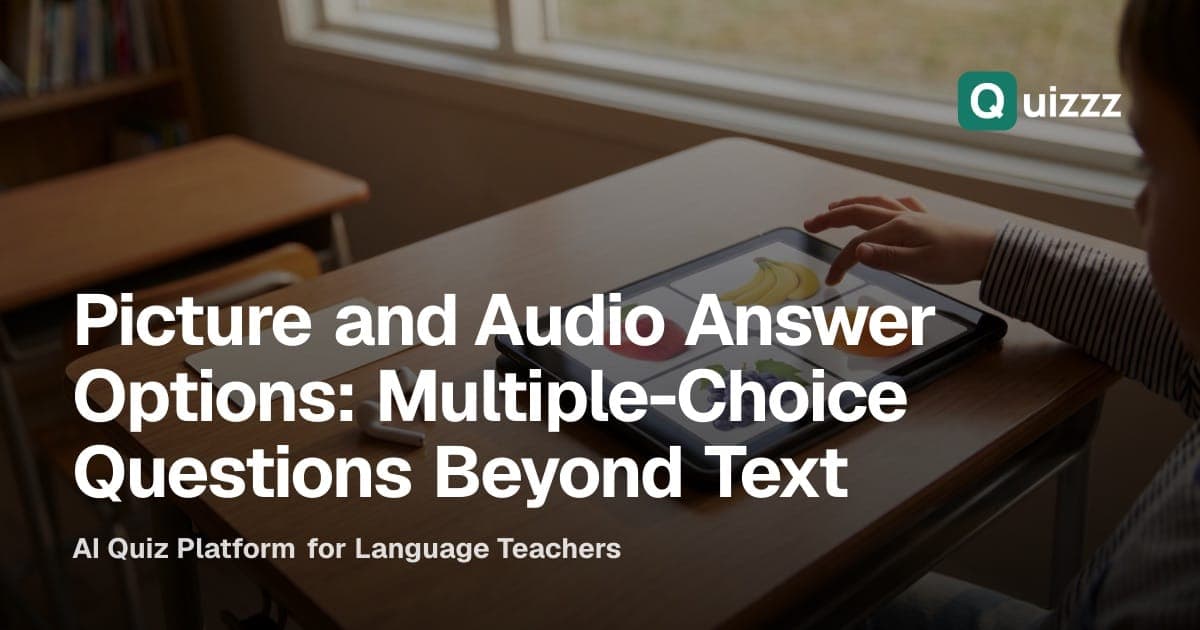
Picture and Audio Answer Options: Multiple-Choice Questions Beyond Text
Each answer option in Quizzz can now carry a picture, an audio clip, or both. Five question ideas for language classes, how to add media in the quiz builder, what students see, and what to know before you assign it.

How to Make a Vocabulary Quiz That Tests More Than Recognition
If every question is "choose the meaning", students pass by recognizing words they cannot use yet. How to mix question types in a vocabulary quiz, turn your word list into one with Quizzz, and keep students reviewing with flashcards and word games.