
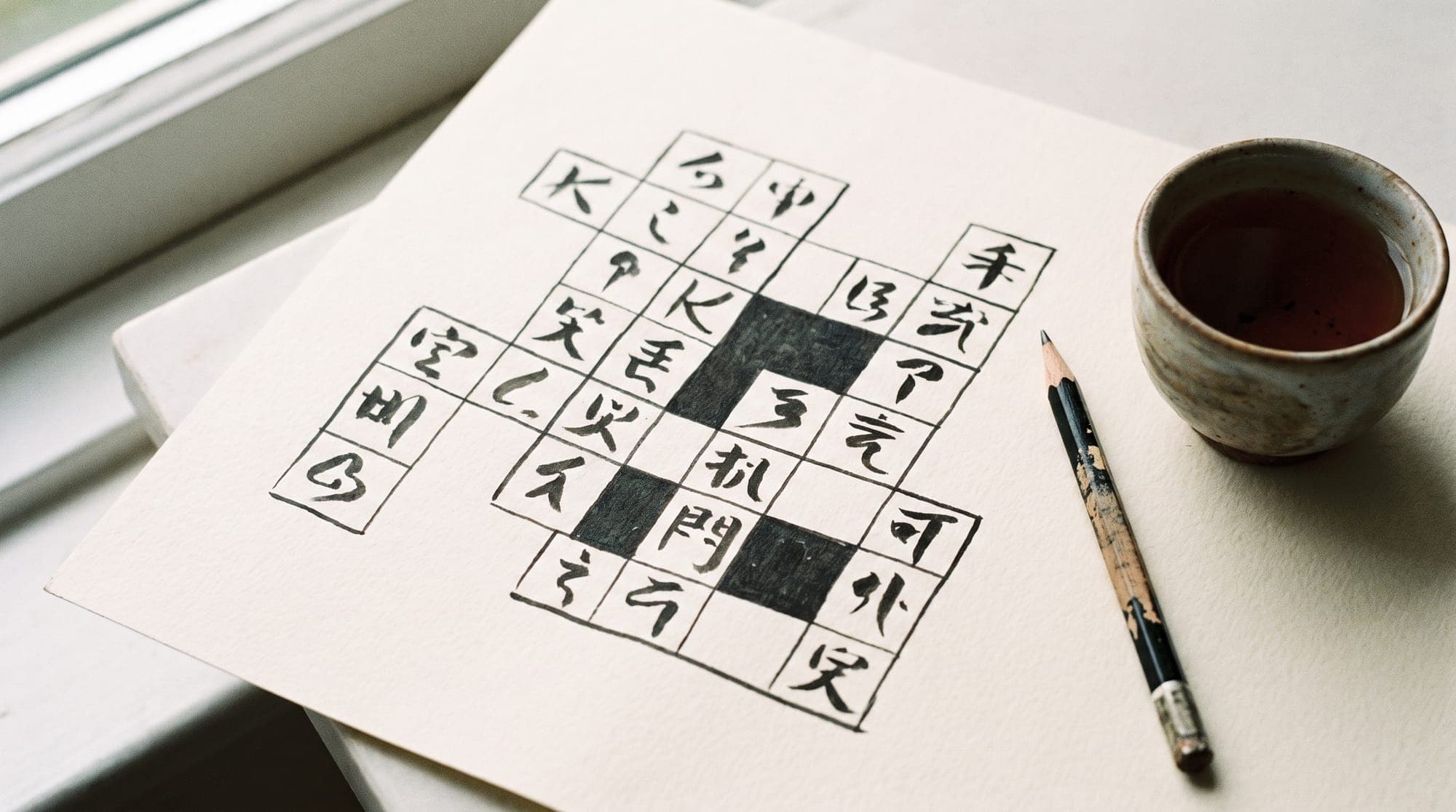
Every Japanese teacher who has tried to make a crossword by hand knows the moment. You have ten good N5 words, you start drawing the grid, and nothing crosses. One word is in katakana, another has a kanji in the middle, and the two that could have shared a character sit at opposite ends of the paper. Forty minutes later you have a word list and a lot of eraser dust.
Chinese is not easier. Each character is one cell, so a two-character word has exactly two chances to cross anything, and a list of unrelated words produces a grid that is mostly empty space.
Quizzz takes the layout problem away. You give it the words and clues, or let the AI draft them from a topic or your material, and it lays out an interlocking grid for you, tells you which words did not fit, and turns the result into a quiz you can assign, share, or embed like any other.
👉 Open Quizzz · Start free · Crossword guide
Why CJK crosswords break, and the two rules that fix them
A crossword engine matches crossing cells exactly. That is where both scripts cause trouble, for different reasons.
- Japanese: write everything in hiragana. Hiragana and katakana for the same sound are different characters, and a kanji cell can never match a kana cell. A Japanese crossword in Quizzz must be entirely hiragana, no katakana and no kanji. Loanwords you would normally write in katakana either go in as hiragana or stay off the list.
- Chinese: one character per cell. Every 字 is a potential crossing point, which is powerful, but only if your words share characters. A themed list (school vocabulary, family, food) crosses far more often than a random one, because 學校, 學生 and 同學 all share 學.
Both rules are about choosing the list well. The grid layout itself is Quizzz's job.
From word list to grid in five steps
- Choose New Quiz, then the Crossword Puzzle tile, and give it a title.
- Enter words and clues, one per line: the answer, a space, then the clue the student will see. Answers need at least two characters. Prefer a table? Switch the word editor to List view for an Answer / Clue grid.
- No list yet? Use Generate words with AI. Give it a topic such as "JLPT N4 verbs", or switch to Material and paste or upload lesson text (
.txt,.md,.pdf,.csv,.xlsx, up to 20,000 characters). Quizzz picks a fully interlocking subset for the grid and keeps the rest as bench words you can add with one click. - Watch the live preview on the right. It redraws as you type and shows the grid size and how many words were placed. Anything that cannot cross is listed as unplaced, so you can respell it, swap it, or drop it.
- Click Save crossword. It lands in your quiz library, ready to assign, share by Magic Link, or embed. If you leave early, your work autosaves as a draft.
Leave a clue blank and the save still works, but Quizzz inserts a placeholder. Replace it with a real definition, translation, or short context before you publish, because students will read it as the actual clue.
Two worked word lists
A Japanese N5 list, all hiragana, themed around the classroom:
がっこう place where students study
せんせい the person who teaches
がくせい a person who studies at school
ともだち someone you like spending time with
えんぴつ you write with it and can erase it
つくえ you sit at it to study
ほん you read it
きょうしつ the room where lessons happen
Notice how many words share kana: がっこう and がくせい share が, せんせい and がくせい share せ, きょうしつ and つくえ share つ. That is what makes a dense grid.
A Chinese list of two-character words, themed around school:
學校 students go here every weekday
老師 the person who teaches the class
學生 a person who studies at school
同學 someone in the same class as you
朋友 a person you like and trust
教室 the room where the class meets
作業 the teacher assigns it after class
考試 you take it to show what you learned
學校, 學生 and 同學 share 學, and 老師 and 教室 can only meet through a word like 教師, so the AI's bench words are worth a look when the grid feels thin.
How students play
A crossword plays in Classic mode only, the whole grid on one page. Students tap a cell to select the word crossing it, and tap the same cell again to switch between across and down. If they try to submit with empty cells, Quizzz asks them to confirm. Grading is word by word, and the review afterwards shows the grid and clue list cross-highlighted so they can see exactly which words they got.
Try our animal vocabulary crossword to feel the tapping flow on a phone before you build your own.
Crossword or word search?
They test different things, and Quizzz has both.
- Crossword: meaning to form. The student reads a clue and must recall and spell the word. Use it to review a themed set the class has already met.
- Word search: form recognition. The student scans a letter grid and recognises the word's shape. Use it as a warm-up, for beginners who are still getting used to kana or character shapes, or for script familiarity before you ask for recall.
The word search tile supports Chinese, Japanese, English, Korean, Spanish, French, German, Italian and Portuguese. You enter four to ten words (two to four characters for Chinese, Japanese and Korean; two to eight letters for Latin scripts), or let the AI draft the list from a topic or your material. Choose whether students see the word list or play in Discovery mode with the list hidden; the review afterwards reveals every answer either way. Students find a word with two taps, first letter then last letter, and words can run in any direction, including backwards.
Word search has its own validation that saves you from an unplayable grid: duplicates are rejected, one word hidden inside another (中文 inside 中文課) is rejected, one word that is another word reversed (上山 and 山上) is rejected, and a word in the wrong script for the selected language is rejected. In each case Quizzz names the clashing words so you can keep one and drop the other.
What it costs
Typing your own words and clues, or loading a template, never uses AI credits. Only the Generate words with AI step draws on your plan's monthly AI quota, the same as regular quiz generation. After saving a crossword you can also create a template link so other teachers can import your title, words and clues into their own library, never your students' data.
If you have a vocabulary list for next week, paste it in and watch the preview. The words that interlock are your crossword. The ones that do not are your word search. Both take less time than drawing one grid by hand. Start on the crossword puzzle maker page, or follow the step-by-step guides for a general crossword and a Japanese crossword.